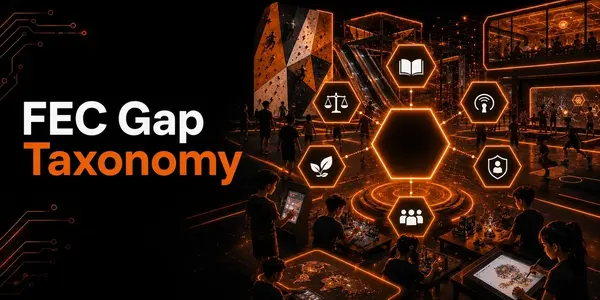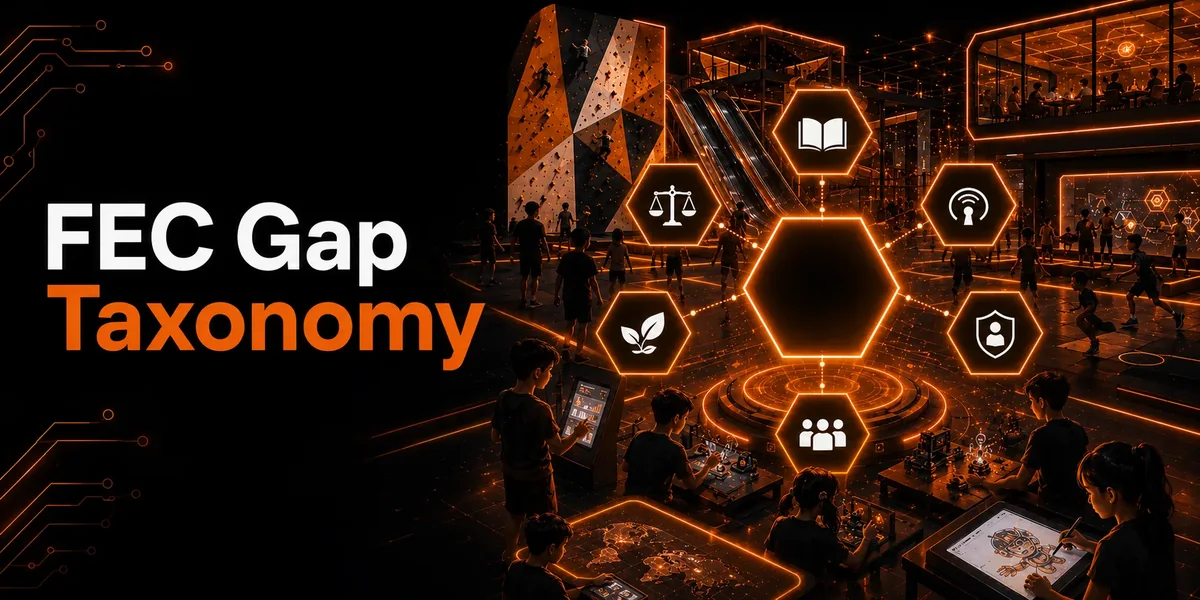
The FEC Gap Taxonomy organizes 128 recurring limitations found across traditional family entertainment centers, indoor playgrounds, trampoline parks, arcades and activity parks. The purpose is not to criticize individual operators. It is to provide a structured way to ask what the next generation of family entertainment can improve.
Many weaknesses are connected. Novelty decay affects repeat visitation. Limited personalization makes later visits feel similar to the first. Passive parent experiences reduce whole-family value. Programming deficits leave the venue dependent on open play and birthdays. Technology can become superficial when it is not connected to progression, creation or the wider visitor journey.
The taxonomy therefore works best as a design tool rather than a checklist. A developer can use the gaps to define requirements before choosing equipment. An operator can use them to identify where programming, staffing, pricing or customer experience needs improvement. A landlord or investor can use them to evaluate whether a concept has a credible long-term traffic and retention strategy.
Several categories are especially important for repeat visitation: novelty and content refresh, personalization and progression, social connection, parent value, developmental value, programming, digital continuity and brand storytelling. Solving only one of these problems rarely creates a complete concept; stronger systems connect them.
The research also changes the development question. Instead of beginning with “Which attractions should we buy?”, a stronger process asks what children need, what families value, what the market is missing and what should make a customer return. Equipment then becomes one part of a larger operating and experience system.
How to use the taxonomy
- Identify the most important gaps for a specific market and audience.
- Translate each priority gap into a measurable design or operating requirement.
- Test solutions with families before and after opening.
- Use the framework to compare concepts beyond attraction count and visual renderings.
- Revisit the gaps as technology, family behavior and competitive conditions change.