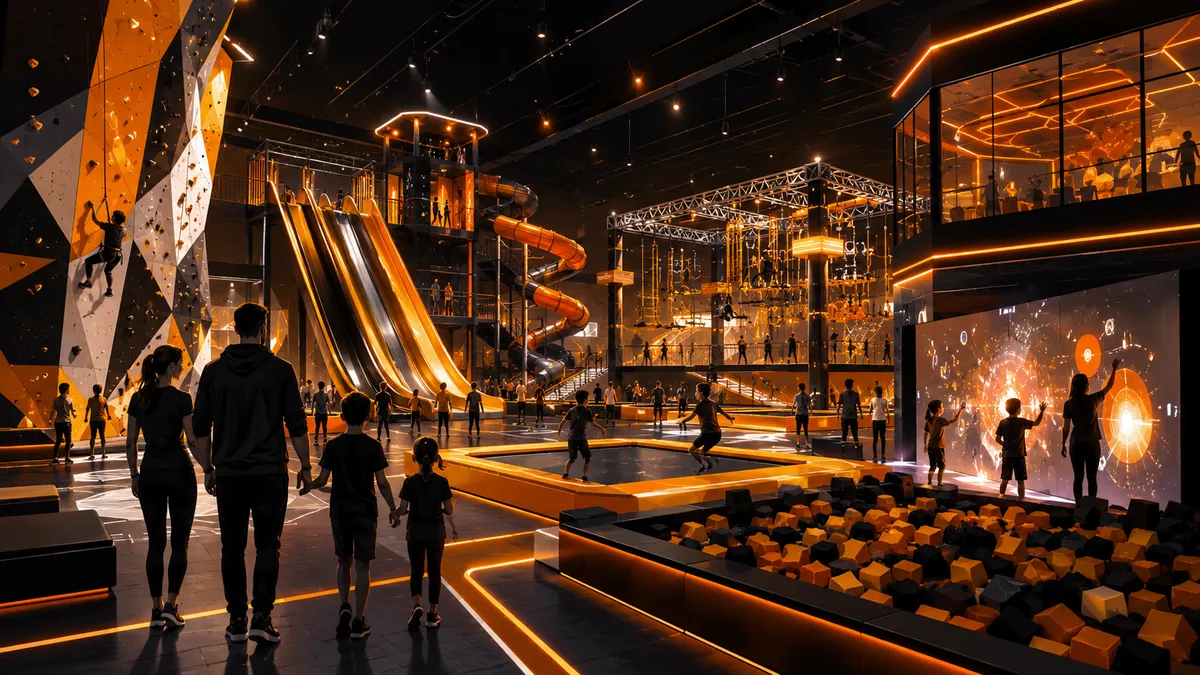
Future-facing family entertainment should not mean replacing movement with screens. Physical, digital, hands-on and social experiences can reinforce one another.
Technology should expand agency
AI can help a child prototype a game, visualize an invention or explore data, but the child should continue to make decisions and create.
Movement remains foundational
Climbing, balancing, jumping, navigating, throwing and team play provide a kind of embodied challenge that a screen cannot replace.
Avoid passive screen dependence
The FEC Gap Taxonomy explicitly identifies passive screen dependence and physical-digital disconnect as risks.
The strongest system is mixed
A child might climb a physical challenge, analyze a result, design an improvement, build a digital prototype and present it to others — one connected journey.
Future Experience design rule: build the experience around the child and family first; choose technology and equipment second.
This article is based on the Future Experience Park concept framework and the FEC Gap Taxonomy. It is intended as a practical industry perspective rather than a claim that every gap applies equally to every venue.